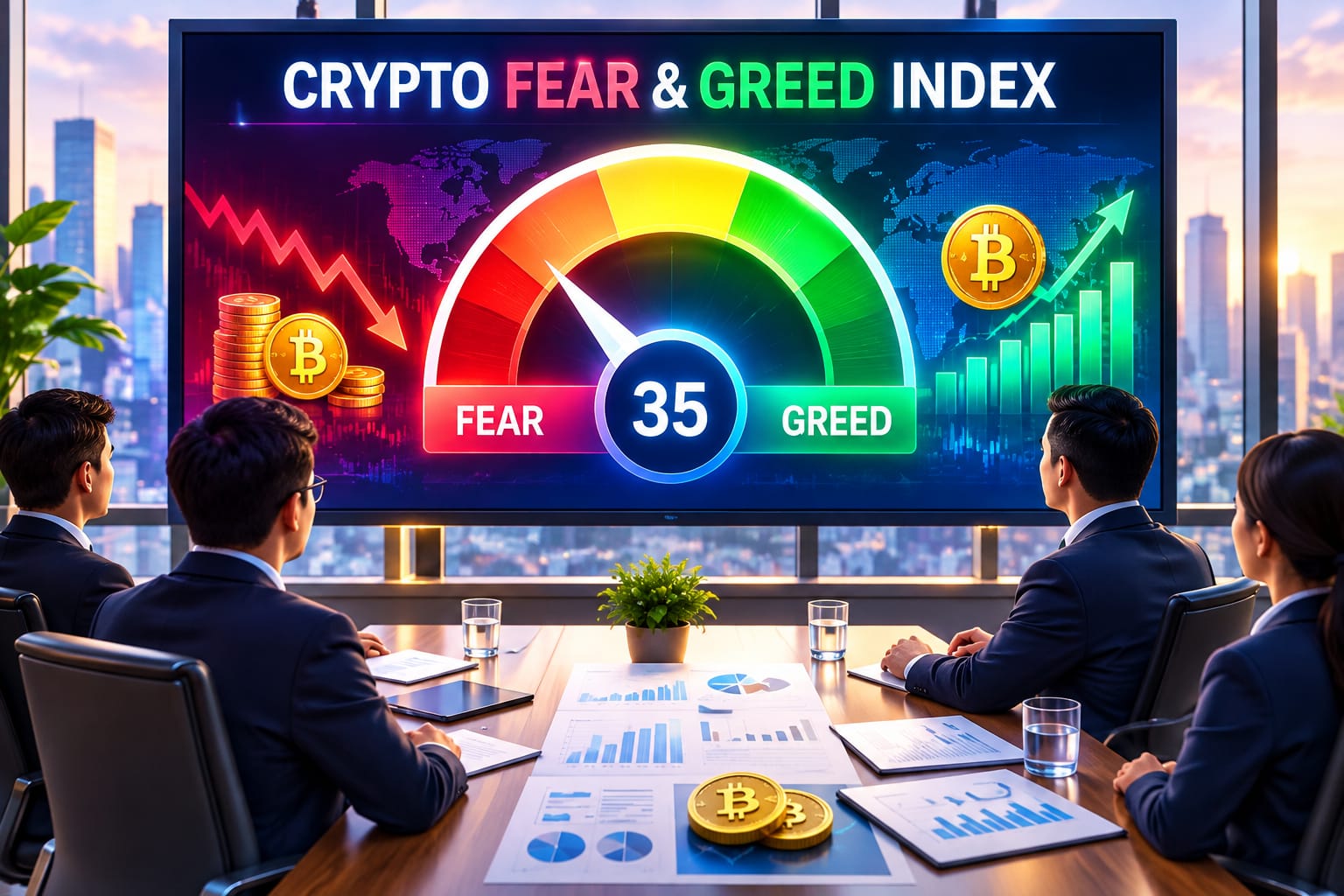
What Does the Fear and Greed Index Say about the crypto market and where it may be heading next? The answer is more nuanced than simply looking at a number and deciding whether the market is bullish or bearish. The index provides a snapshot of investor sentiment, risk appetite and the emotional pressure influencing market participants.
Fear and greed can shape the way investors respond to price movements, uncertainty and changing market conditions. When sentiment shifts sharply, it can affect trading behaviour, confidence and willingness to take risk. But sentiment does not always move in the same direction as price, which makes the relationship between the two more interesting than the index reading alone.
That is why the Fear and Greed Index is better viewed as one part of a broader market picture. Its reading can provide useful context, but understanding what it may mean for the next phase requires looking beyond the number — at investor behaviour, market positioning, price action and the wider crypto environment.
The Fear and Greed Index Is Only One Part of the Market Story
A Fear and Greed Index compresses several market and behavioural signals into a single sentiment reading. The widely followed Alternative.me version uses factors such as volatility, market momentum and volume, social activity, Bitcoin dominance and search trends. Other providers use different methodologies, which means two indexes can produce different readings at the same time.
That distinction matters.
A market can be fearful while some individual assets remain strong. It can also show greed while parts of the market are already losing momentum. A single number therefore provides context, but it does not describe every part of the crypto ecosystem.
The index is better viewed as a market mood indicator than a complete picture of market conditions.
What the Index Says About Investor Psychology
Fear and greed are ultimately expressions of human behaviour.
When fear becomes dominant, investors may become more defensive, reduce exposure to risk, hesitate to enter new positions or react strongly to negative developments. When greed takes over, confidence can turn into FOMO, aggressive buying and greater willingness to accept risk.
This is particularly relevant in crypto because market narratives can change quickly. A period of optimism can create strong momentum, while a sharp decline can rapidly turn confidence into uncertainty.
The important insight is that sentiment does not simply follow price. Sentiment and price can influence each other.
When Sentiment Moves Faster Than Price
There are periods when investor sentiment changes before the price trend clearly changes.
A market may become increasingly fearful while prices are still relatively stable because investors are becoming less comfortable with risk. On the other side, sentiment can remain optimistic even after momentum begins to weaken.
This creates an important gap between what investors feel and what the market is actually doing.
That gap can be more informative than the absolute index reading itself. A move from fear toward neutral, for example, may indicate improving confidence even if prices have not yet made a major recovery.
When Price and Sentiment Tell Different Stories
One of the most interesting situations occurs when price and sentiment disagree.
Crypto prices may rise while the Fear and Greed Index remains relatively cautious. That can indicate that the price recovery has not yet convinced the broader market.
The opposite can also happen. Sentiment may remain extremely optimistic while price momentum starts weakening. In that situation, confidence may be running ahead of the underlying market move.
Neither situation automatically predicts what happens next. But both deserve attention because divergence can reveal uncertainty that a price chart alone may not show.
What Fear Can Reveal About Market Positioning
Fear is not simply a statement that investors expect prices to fall.
It can also indicate that market participants are becoming less willing to take risk. Traders may become more selective, reduce leverage or wait for clearer confirmation before committing capital.
At extreme levels, fear can also create very different reactions. Some participants may sell because they want to reduce risk, while others may start looking for opportunities created by heavy selling.
This is why an extreme fear reading should not automatically be interpreted as either a buying opportunity or a warning to stay away.
It tells us that the market is under emotional pressure. It does not tell us exactly how that pressure will resolve.
What Greed Reveals Beyond Rising Prices
Greed is equally complex.
Strong optimism can support rising prices because investors become more willing to participate and chase momentum. But prolonged optimism can also encourage excessive risk-taking.
This is where FOMO becomes important. When investors believe an asset will continue rising, the fear of missing the next move can become more powerful than a careful assessment of risk.
Extreme greed therefore deserves attention not because it guarantees a market decline, but because it can indicate that expectations and risk-taking have become unusually elevated.
Markets can remain greedy for much longer than expected during powerful trends. That is one reason the index should never be treated as a mechanical sell signal.
The Market Does Not Have One Investor Mindset
Another reason sentiment needs context is that crypto markets contain different types of participants.
A short-term trader may react to a sudden sentiment change within hours. A long-term investor may view the same move as part of a much larger market cycle. Someone holding a concentrated position may respond differently from someone managing a diversified portfolio.
The same Fear and Greed reading can therefore produce completely different decisions.
This is why market sentiment should be understood as a collective environment, rather than a universal instruction for every investor.
Bitcoin Sentiment Is Not Always the Same as the Whole Crypto Market
There is another limitation that is easy to overlook.
Some widely followed crypto Fear and Greed measures are heavily influenced by Bitcoin-related data. Alternative.me’s methodology, for example, incorporates Bitcoin volatility, momentum and volume, social activity, Bitcoin dominance and search trends.
That means the overall reading can provide useful information about the broader market environment, but it may not accurately describe what is happening in every altcoin, sector or crypto narrative.
Bitcoin can be relatively strong while certain altcoins are under pressure. Likewise, a particular sector can experience strong enthusiasm while broader market sentiment remains cautious.
For investors, that difference matters.
Can Sentiment Become a Market Force?
Sentiment can sometimes create a feedback loop.
Fear can encourage risk reduction and selling, which can contribute to further weakness and create even more fear. Greed can encourage momentum chasing, which can attract additional buyers and reinforce optimism.
This does not mean sentiment controls the market by itself. Fundamental developments, liquidity, macroeconomic conditions, regulation, technology and market structure can all change the direction of crypto markets.
But once a strong emotional trend develops, it can influence how investors interpret new information.
The same news can be viewed differently in a fearful market than in a highly optimistic one.
That is one of the most important insights behind the Fear and Greed Index.
Sentiment Is Not the Same as Conviction
A high Fear and Greed reading does not necessarily mean investors have strong conviction about the long-term value of an asset.
Likewise, extreme fear does not automatically mean investors have concluded that the underlying technology or market has failed.
Sentiment describes the emotional environment. Conviction involves a deeper belief about future value.
Confusing the two can lead to poor conclusions.
An investor may be optimistic because prices are rising, while another may be optimistic because of long-term fundamentals. These are very different forms of confidence, even though both may contribute to a similar sentiment reading.
What the Index Cannot Tell You
The Fear and Greed Index does not tell investors whether an asset is fundamentally undervalued or overvalued. It does not identify the exact timing of a market bottom or top, and it cannot reliably predict the next price move by itself.
Research and recent analysis also reinforce the distinction between describing current sentiment and predicting future prices. The index can be useful for understanding the emotional environment without necessarily providing a reliable forecast of what happens next.
There is also no single universal methodology. Alternative.me and CoinMarketCap, for example, calculate their respective sentiment indexes using different inputs.
So before interpreting a number, it is worth asking a simple question:
Which Fear and Greed Index are we actually looking at?
So, What Does the Fear and Greed Index Say About the Next Phase?
The most useful answer is not that fear means the market will rise or greed means it will fall.
Instead, the index can show how much emotional pressure is present in the market and how willing participants appear to be to take risk.
If fear is extreme, the market may be experiencing significant uncertainty, defensive behaviour or selling pressure. If greed is extreme, confidence and risk-taking may be elevated. Neither condition guarantees a reversal.
The bigger insight comes from combining sentiment with the behaviour of price, trading activity, market participation and the broader crypto environment.
A Fear and Greed reading can therefore help investors ask better questions:
Is sentiment improving or deteriorating?
Is price confirming that change?
Are investors becoming more confident or simply chasing momentum?
Is fear creating genuine weakness, or is the market absorbing selling pressure?
Is optimism supported by broader participation, or is it becoming excessive?
Those questions are more valuable than treating one number as a prediction.
Conclusion
The Crypto Fear and Greed Index is best understood as a window into market psychology, not a crystal ball for crypto prices.
Its value lies in helping investors understand the emotional environment surrounding the market — how fear, confidence, FOMO and risk-taking may be influencing behaviour.
The next market phase will not be determined by sentiment alone. But when the Fear and Greed Index is viewed alongside price action, market participation and the wider crypto landscape, it can provide an important piece of the bigger picture.
The real insight is not simply whether the market is fearful or greedy. It is understanding what that emotion is doing to market behaviour — and whether the market itself is confirming it.
Disclaimer : This article is for educational and informational purposes only and should not be considered financial or investment advice.