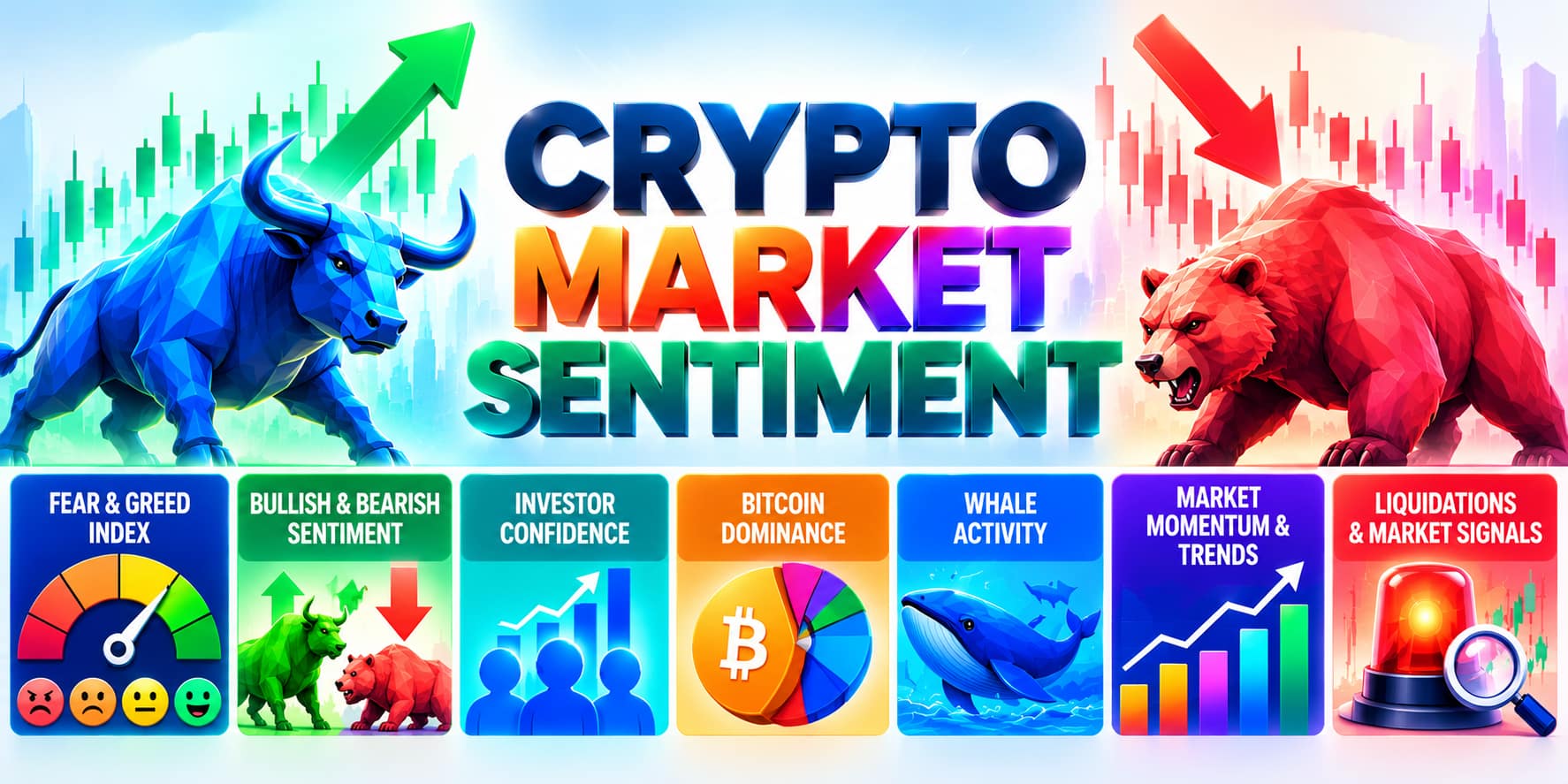
Crypto Market Sentiment reflects the overall mood, confidence, expectations and risk appetite of investors and traders in the cryptocurrency market. It helps explain whether market participants are becoming more optimistic, cautious, fearful or willing to take greater risks at a particular time.
Crypto markets are influenced not only by prices and fundamentals but also by investor psychology. Strong optimism can increase buying interest and speculation, while fear can lead to selling pressure and reduced risk-taking. Because crypto markets can change quickly, understanding sentiment can provide useful context for interpreting market movements.
Crypto Market Sentiment is not a tool for predicting every price move or generating automatic buy and sell signals. Instead, it can be used alongside price action, trading volume, volatility, market positioning, on-chain data and other relevant indicators to build a more complete view of market conditions.
Why Crypto Market Sentiment Matters
Crypto markets can move rapidly because expectations often change before the underlying fundamentals do.
For example, strong optimism can encourage traders to chase rising prices, while fear can cause investors to reduce positions even when the long-term fundamentals of an asset have not changed significantly.
Studying sentiment can therefore help users understand:
- Whether the market is becoming more optimistic or defensive
- Whether traders are taking more or less risk
- Whether positions appear crowded
- When market emotions may be reaching an extreme
- How investors are reacting to changing market conditions
The goal is not to predict every price movement, but to understand the environment in which those movements are happening.
Fear & Greed
The Fear & Greed Index is one of the most commonly used sentiment indicators in crypto. It combines several market and behavioral factors into a simplified score, generally ranging from fear to greed.
Depending on the provider, the methodology can include volatility, market momentum, trading volume, social activity, Bitcoin dominance and search trends. Different providers can therefore produce different readings.
Extreme fear may indicate that investors are highly cautious, while extreme greed can indicate strong optimism and increased risk-taking. Neither condition should automatically be treated as a buy or sell signal.
Whale Activity
Large holders, often called whales, can have a significant influence on market liquidity and short-term price movements.
Tracking large transfers, exchange inflows and outflows, and changes in major wallet balances can provide additional context about how large participants may be positioning themselves.
However, a large transaction does not automatically mean a whale is buying or selling. The destination, timing and broader market conditions also matter.
Bitcoin Dominance
Bitcoin dominance measures Bitcoin’s share of the overall cryptocurrency market capitalization.
Changes in dominance can provide clues about capital allocation across the market. Rising dominance may occur when investors favor Bitcoin over higher-risk altcoins, while falling dominance can sometimes accompany stronger interest in other crypto assets.
It is best interpreted together with price trends, liquidity and broader market conditions rather than in isolation.
Market Momentum and Trading Volume
Price momentum and trading volume help show whether market participation is strengthening or weakening.
A price move supported by strong trading activity can indicate broader participation, while a large move on relatively weak volume may deserve closer examination.
Combining price direction with volume can help investors distinguish between a market move that has strong participation and one that may have limited conviction.
Market Volatility
Volatility measures how sharply prices are moving over time.
Rising volatility often accompanies uncertainty, fear, major market events or aggressive speculation. Lower volatility can indicate a quieter market, although it does not necessarily mean that risk has disappeared.
Watching volatility alongside price, volume and sentiment can provide a clearer picture of the market environment.
Derivatives Market Sentiment
The derivatives market provides another view of trader positioning. Three commonly watched indicators are funding rates, open interest and long/short positioning.
Funding Rates
Funding rates show the cost exchanged between long and short positions in perpetual futures.
Persistently positive funding can indicate stronger demand for leveraged long positions, while negative funding can indicate greater demand for shorts. Extremely one-sided funding can also highlight crowded positioning and potential leverage risk.
Open Interest
Open interest represents the value of outstanding futures or options contracts.
Changes in open interest can help show whether leverage is entering or leaving the market. For example, rising open interest alongside price movement may indicate increasing participation, while falling open interest can indicate positions being closed or leverage being reduced.
Long/Short Positioning
Long/short data shows how traders are positioned in derivatives markets.
An unusually strong concentration on one side can indicate crowded positioning. But long/short ratios should not be interpreted as guaranteed predictions because positioning can change quickly.
Social and Search Sentiment
Crypto discussions on social platforms can change rapidly. The number of discussions, engagement levels and the tone of conversations can provide clues about public interest and market mood.
Search trends can also show when interest in Bitcoin or other cryptocurrencies is increasing or decreasing.
These signals are useful for understanding attention and sentiment, but social activity can also be driven by speculation, misinformation or short-term hype.
On-Chain Sentiment Signals
Blockchain data provides another way to study market behavior.
Depending on the asset and network, useful signals can include:
- Exchange inflows and outflows
- Active addresses
- Network activity
- Holder behavior
- Realized gains and losses
- Accumulation and distribution patterns
For example, changes in exchange flows can provide clues about potential selling or accumulation behavior, while holder data can help show whether investors are realizing profits or losses.
On-chain data is most useful when combined with price and market-positioning information rather than interpreted as a single directional signal.
Bullish vs Bearish Sentiment
Bullish sentiment generally reflects growing confidence, optimism and willingness to take risk. It can be associated with rising prices, stronger participation and increased demand.
Bearish sentiment reflects increasing caution, uncertainty or pessimism. It can appear alongside falling prices, reduced risk-taking and defensive positioning.
Neither bullish nor bearish sentiment guarantees what happens next. Markets can remain optimistic longer than expected, and extreme fear does not automatically mean that a bottom has formed.
How Crypto Market Sentiment Changes
Sentiment can change because of many factors, including:
- Large price movements
- Major crypto market events
- Bitcoin and Ethereum developments
- Institutional activity
- ETF flows
- Changes in liquidity
- Network developments
- Security incidents
- Macroeconomic conditions
- Social and media attention
A single event can sometimes shift market psychology quickly, which is why sentiment should be viewed as a changing market condition rather than a permanent classification.
How Investors Can Use Market Sentiment
Long-term investors can use sentiment to understand whether the market is becoming excessively optimistic or pessimistic.
Instead of reacting emotionally to every sentiment change, investors can use it as additional context when reviewing their portfolio, risk exposure and investment plan.
Sentiment can be particularly useful for recognizing periods when market expectations appear unusually extreme.
How Traders Can Use Market Sentiment
Traders can use sentiment to complement technical and market-structure analysis.
For example, a trader may compare price action with volume, funding rates, open interest, volatility and positioning to understand whether a move is supported by broader participation or accompanied by excessive leverage.
This approach can help traders identify potential risks such as crowded positions, sudden volatility and possible liquidation pressure. Current market-positioning research also commonly combines derivatives, flows, options and market-depth data to assess risk appetite.
Limitations of Crypto Market Sentiment
Sentiment is useful, but it has clear limitations.
Social media can be noisy, whale movements can be difficult to interpret, and sentiment indicators can remain extreme for longer than expected. Different platforms can also use different methodologies and produce different results.
Most importantly, sentiment does not tell you with certainty where the price will go next.
For that reason, sentiment analysis works best when combined with technical analysis, fundamental research, on-chain data and proper risk management.
How to Read Crypto Market Sentiment
The most practical approach is to avoid relying on one indicator.
Instead, look at several signals together:
Fear & Greed + Price + Volume + Volatility + Bitcoin Dominance + Funding Rates + Open Interest + On-Chain Data + Social Activity
When several independent indicators point in a similar direction, they can provide stronger context than any single sentiment reading.
The objective is not to find a perfect signal. It is to understand how participants are positioned, how much risk they are taking and how market psychology is changing.
What We Cover
Our Crypto Market Sentiment coverage focuses on the indicators and market behaviors that help readers understand changing crypto market psychology, including:
- Fear & Greed
- Whale Activity
- Bitcoin Dominance
- Market Momentum
- Trading Volume
- Volatility
- Funding Rates
- Open Interest
- Long/Short Positioning
- Options Sentiment
- Social & Search Sentiment
- On-Chain Signals
- Market Psychology
The focus is on practical information that helps investors and traders better understand the market environment without treating sentiment as a guaranteed prediction tool.
Disclaimer: This content is for educational and informational purposes only and is not financial or investment advice. Crypto assets involve significant risk.