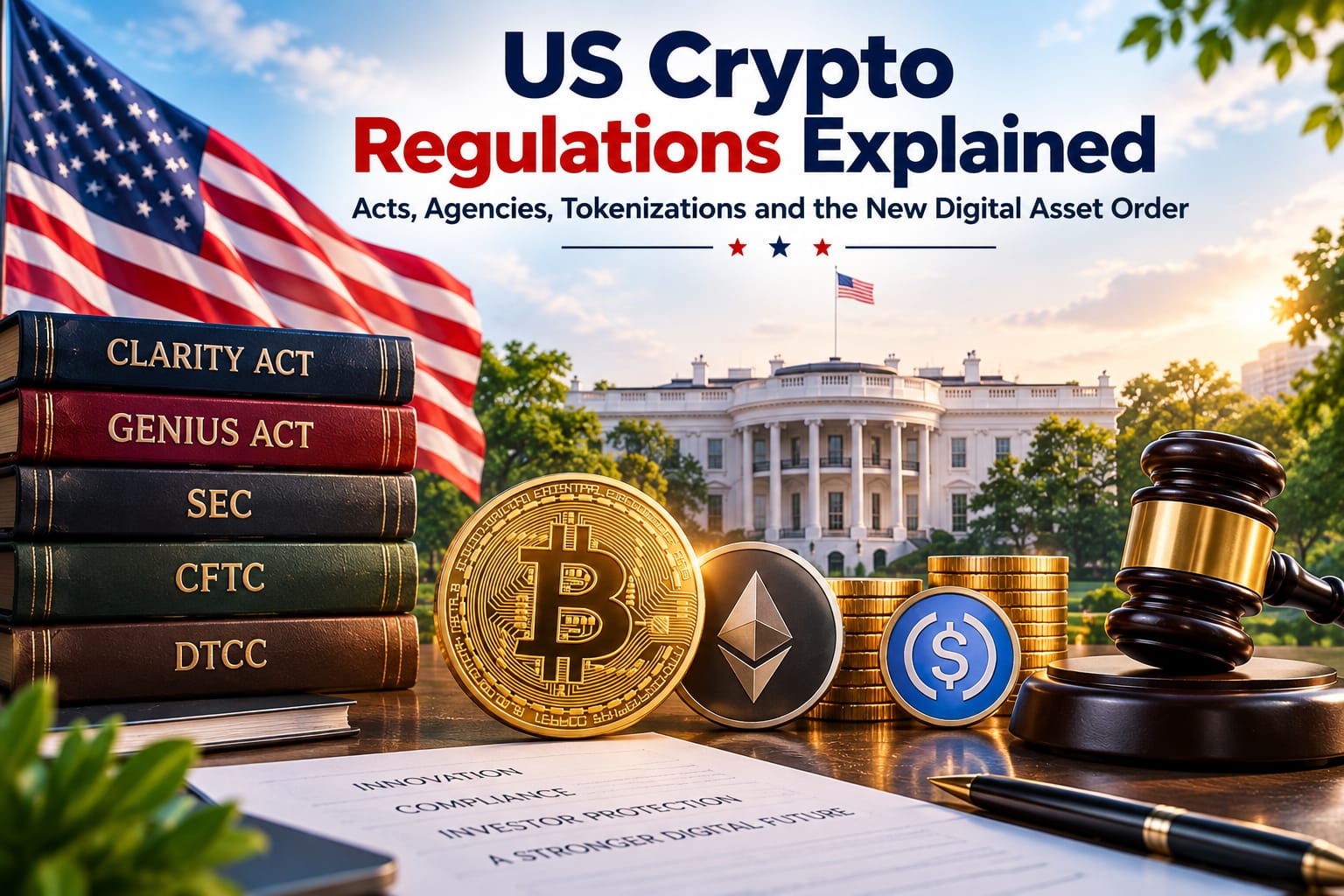
US Crypto Regulations Explained is no longer just a story about whether a cryptocurrency is treated as a security or a commodity. The United States is building a broader digital-asset framework involving federal agencies, new legislation, stablecoin rules, exchange oversight, custody standards, tokenization and executive policy. The result is a regulatory system that is becoming more defined, but still operates through several overlapping layers.
The U.S. Regulatory Power Center Behind Crypto
Unlike countries that may place most digital-asset activity under one central regulator, the United States divides crypto oversight across multiple institutions.
The Securities and Exchange Commission (SEC) remains central when digital assets or transactions fall within federal securities laws. The Commodity Futures Trading Commission (CFTC) has an important role in commodity derivatives and, increasingly, the regulatory framework surrounding digital commodities.
Other institutions also matter. The Financial Crimes Enforcement Network (FinCEN) focuses on anti-money-laundering obligations, while banking regulators and state authorities can become relevant depending on the business model.
This creates a system where the same crypto business may face different requirements depending on what it issues, how it operates, what assets it holds and which financial services it provides.
SEC and CFTC: The Security–Commodity Divide
One of the biggest changes in U.S. crypto regulation is the effort to draw clearer lines between digital securities and digital commodities.
In March 2026, the SEC issued an interpretation, joined by the CFTC, establishing a clearer taxonomy covering digital commodities, digital collectibles, digital tools, stablecoins and digital securities. The interpretation also addresses areas such as staking, airdrops and investment contracts.
Bitcoin and several other established crypto assets are treated as examples of digital commodities under the agencies’ 2026 framework.
The significance is bigger than terminology. Classification can influence which regulator has authority, what disclosures apply, how a platform can operate and what obligations may apply to issuers and intermediaries.
The Major Acts Reshaping U.S. Crypto Regulation
There is no single “U.S. Crypto Act” covering everything. Instead, several legislative initiatives address different parts of the ecosystem.
GENIUS Act: The Federal Stablecoin Framework
The GENIUS Act is one of the most important completed pieces of U.S. crypto legislation.
Signed into law in July 2025, it established the first federal regulatory framework specifically for payment stablecoins. Among other requirements, it provides for reserve backing, disclosures, compliance obligations and restrictions designed to protect users and strengthen the integrity of the stablecoin market.
This matters beyond stablecoins themselves. Dollar-backed digital assets sit at the intersection of crypto markets, payments, Treasury markets and the international role of the U.S. dollar.
CLARITY Act: The Broader Market-Structure Framework
The CLARITY Act addresses a much larger question: who regulates digital assets and the businesses that trade them?
The proposed framework seeks to establish clearer boundaries between the SEC and CFTC and create rules for digital-asset intermediaries, including exchanges, brokers and dealers.
The House passed its version in 2025, while a Senate committee advanced another version in 2026. As of September 2026, however, it has not yet become federal law.
If enacted, the CLARITY Act could become one of the most important structural changes to the U.S. crypto market because it would move the industry toward a more clearly defined regulatory architecture.
The New Digital Asset Policy Direction
U.S. crypto policy has also moved beyond individual enforcement actions and individual tokens.
The January 2025 executive order on digital financial technology established a Presidential Working Group on Digital Asset Markets and directed the federal government toward developing a regulatory framework for digital assets and stablecoins.
A further executive order issued in May 2026 focused on integrating digital assets and financial technology into traditional financial services and payment systems while reducing outdated or fragmented regulatory barriers.
Together, these policies show a broader direction: the United States is attempting to move from regulatory uncertainty toward integration, clearer rules and greater institutional participation.
Tokenization: Where Traditional Finance Meets Blockchain
Tokenization may ultimately be one of the most important parts of the U.S. digital-asset strategy.
A tokenized security represents an existing financial instrument in digital form, with ownership records maintained partly or entirely through a blockchain or other crypto network. The SEC now explicitly distinguishes digital securities from other categories of crypto assets.
This means tokenization is not simply about creating another cryptocurrency. It can involve bringing stocks, bonds and other financial assets into blockchain-based infrastructure.
The DTCC is an important example of this transition.
In 2025, DTC received an SEC no-action letter supporting a service for tokenizing DTC-custodied assets. In 2026, DTCC reported successful production trades involving DTC-tokenized securities and announced plans for its tokenization service.
That is significant because it connects blockchain technology with one of the core infrastructures of traditional U.S. securities markets.
Exchanges, Brokers and Digital-Asset Intermediaries
Crypto exchanges are increasingly becoming part of the broader financial regulatory conversation.
The future U.S. framework is moving toward clearer expectations around registration, operational standards, customer protection, disclosures, AML controls and the separation of different types of digital-asset activities.
This is particularly important because an exchange does more than provide a trading interface. Depending on its business model, it may also provide custody, brokerage, settlement, staking, lending or other services.
Regulation therefore increasingly focuses on what the platform actually does, rather than simply calling it a “crypto exchange.”
Crypto Custody and Investor Protection
Custody is another major regulatory issue.
When a platform holds digital assets for customers, questions arise around asset segregation, operational controls, cybersecurity, access to private keys, bankruptcy risk and the treatment of customer assets.
The regulatory direction is gradually moving toward a financial-services model in which custody cannot be treated as an afterthought.
For investors, this distinction matters: owning a crypto asset and having a regulated institution hold that asset for you are two different regulatory situations.
Security, Commodity, Stablecoin or Tokenized Asset?
The U.S. framework is increasingly trying to answer this classification question before determining the applicable rules.
A simplified picture looks like this:
- Digital securities → primarily connected with securities laws and SEC oversight.
- Digital commodities → increasingly connected with CFTC jurisdiction and commodity-market rules.
- Payment stablecoins → subject to the federal framework established by the GENIUS Act.
- Tokenized securities → traditional financial instruments represented through digital networks.
- Digital tools and collectibles → categories recognized within the SEC/CFTC 2026 framework.
The important point is that “crypto” is not one regulatory category. Different digital assets can have different legal characteristics and therefore different regulatory treatment.
What U.S. Crypto Regulation Means for the Global Market
The importance of U.S. crypto regulation extends far beyond American investors.
The United States remains one of the world’s largest financial markets. Rules governing stablecoins, tokenized securities, exchanges, custody and digital commodities can influence how global companies design products and where they choose to operate.
Clearer U.S. rules could encourage more institutional participation and bring blockchain infrastructure deeper into traditional finance. At the same time, compliance requirements could raise costs for smaller businesses and create new barriers to entry.
The real competition may therefore not be simply between Bitcoin and other cryptocurrencies. It may be between traditional financial infrastructure and blockchain-based financial infrastructure.
The Bigger Picture
The U.S. crypto regulatory story is moving from a fragmented debate over individual tokens toward a much broader financial-market framework.
The SEC and CFTC are working toward clearer asset classifications. GENIUS has established a federal stablecoin framework. CLARITY is attempting to create broader market-structure rules. Executive policy is pushing digital assets closer to traditional finance. DTCC is demonstrating how tokenization can connect blockchain infrastructure with established securities markets.
That combination makes the United States one of the most important regulatory power centers shaping the next phase of the global crypto industry.
The biggest question is no longer simply whether crypto will fit into the existing financial system.
It is how much of the future financial system will itself become digital and tokenized.
FAQs
Can the SEC and CFTC regulate the same crypto asset?
Their jurisdiction can overlap depending on the asset, transaction and activity involved. The newer joint framework is intended to make those boundaries clearer.
Does the GENIUS Act regulate Bitcoin?
No. The GENIUS Act primarily establishes the federal framework for payment stablecoins rather than creating a general regulatory regime for Bitcoin.
Is the CLARITY Act already U.S. law?
No. The CLARITY Act has advanced through Congress but, as of September 2026, has not yet become federal law.
Why is DTCC involved in crypto tokenization?
DTCC’s role is important because tokenization can bring blockchain-based ownership and settlement infrastructure into traditional securities markets. Its DTC subsidiary is developing a service for tokenized DTC-custodied assets.
Does crypto regulation make every crypto investment safer?
No. Regulation can establish compliance, disclosure and consumer-protection requirements, but it does not eliminate market volatility, technology risks or investment losses.
Will tokenization replace traditional financial markets?
Not necessarily. A more likely development is increasing integration between traditional financial infrastructure and blockchain-based systems, with tokenization becoming another way to represent and move financial assets.