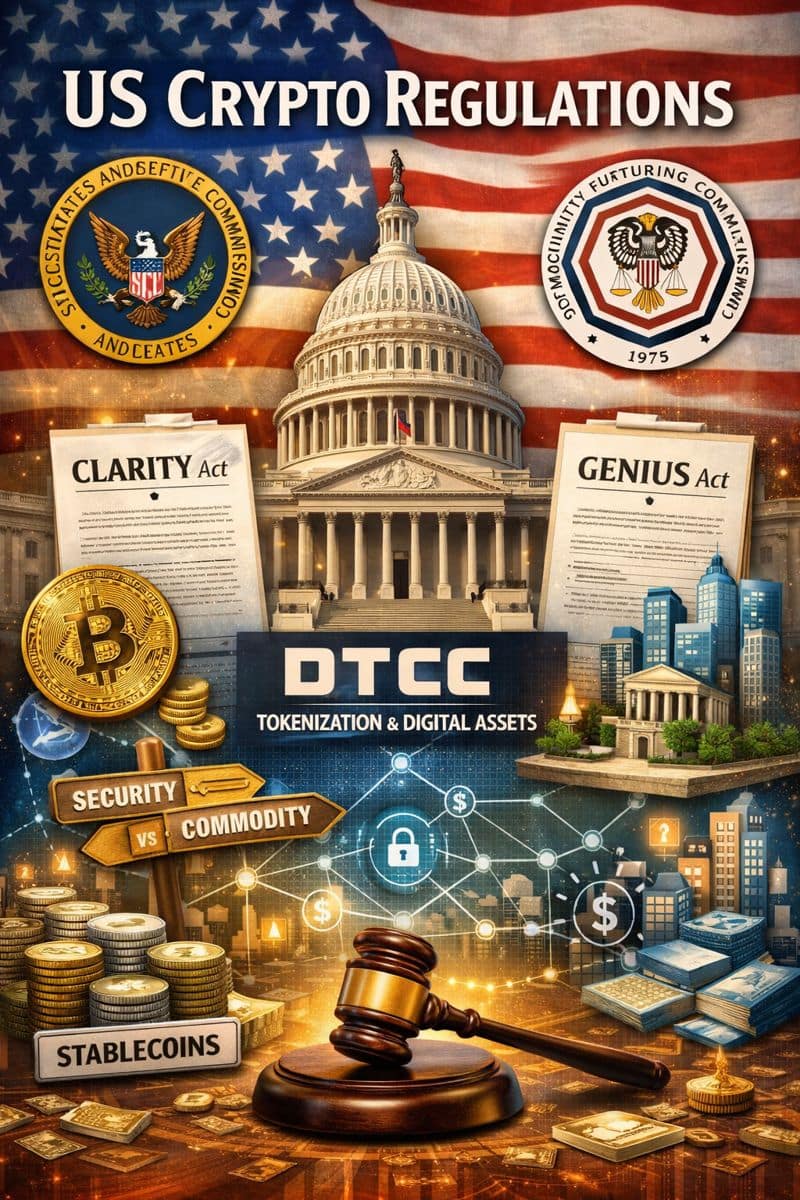
🔥 America’s Crypto Rulebook Is Being Rewritten — And the World Is Watching
The United States has entered a decisive phase in crypto regulation. What was once a fragmented system driven by enforcement actions is now evolving into a structured, law-backed framework that could redefine how digital assets, tokenized securities, and blockchain-based finance operate globally.
From Congressional acts to federal agencies, and from tokenization of real-world assets to the democratization of digital finance, US crypto regulation is no longer theoretical — it is becoming institutional reality.
⚖️ Is Crypto Legal in the United States?
✅ Yes. Cryptocurrencies are legal to buy, sell, and hold in the US
❌ No. They are not legal tender
Crypto exists within US financial law, but how an asset is classified — as a security, commodity, or payment instrument — determines which rules apply.
👉 This classification debate is the core of every US crypto regulation.
🏛️ The Regulatory Power Centers Shaping Crypto
🛡️ SEC: Securities Enforcement at the Core
The U.S. Securities and Exchange Commission (SEC) argues that most crypto tokens qualify as securities under existing law.
SEC priorities include:
- Token offerings as investment contracts
- Exchange and broker registration
- Staking and yield products scrutiny
- Investor protection & disclosures
🔴 Result: Aggressive enforcement, lawsuits, and compliance pressure.
⚖️ CFTC: Commodities and Market Integrity
The Commodity Futures Trading Commission (CFTC) maintains that Bitcoin and Ethereum are commodities.
CFTC focus areas:
- Crypto futures and derivatives
- Market manipulation prevention
- Expanding spot-market oversight
👉 The SEC vs CFTC divide is one of the main reasons Congress stepped in.
📜 The Major Crypto Acts Reshaping US Regulation
🧩 CLARITY Act (Crypto Legal Accountability & Regulatory Transparency)
🟢 One of the most critical proposals in US crypto law.
What it does:
- Clearly defines security vs commodity
- Introduces decentralization benchmarks
- Limits regulation by enforcement
- Creates predictable compliance pathways
👉 Goal: Rules first, lawsuits later.
GENIUS Act (Stablecoins & Payment Tokens)
Focused on stablecoins and digital payments.
Key elements:
- 1:1 reserve backing requirements
- Issuer licensing & audits
- Consumer redemption rights
- Financial stability safeguards
👉 Designed to prevent systemic risk while allowing stablecoins to scale.
🏗️ Market Structure & Digital Asset Bills
These proposals aim to:
- Define crypto exchange registration rules
- Establish custody and asset segregation standards
- Align crypto platforms with traditional finance
👉 This marks a shift from uncertainty to structure.
🏦 DTCC and Tokenization: The Institutional Shift
The Depository Trust & Clearing Corporation (DTCC), which clears quadrillions of dollars in traditional assets, is actively exploring blockchain-based settlement and tokenization.
Why DTCC Matters:
- Tokenization of bonds, funds, and real-world assets
- Faster settlement cycles
- Reduced counterparty risk
- Integration of crypto with legacy finance
👉 This is not retail hype — this is Wall Street infrastructure adapting to blockchain.
🌐 Tokenization & the Democratization of Digital Assets
US regulators increasingly view tokenization as:
- A way to democratize access to assets
- Improve market efficiency
- Lower barriers for global participation
Tokenized assets could include:
- Bonds
- Funds
- Real estate
- Carbon credits
👉 Regulation here is not about stopping crypto — it’s about controlling scale and risk.
🏦 Exchanges, Custody & Compliance: The New Normal
Under the emerging framework, US crypto platforms must:
- Register with appropriate regulators
- Maintain strict KYC & AML standards
- Segregate customer funds
- Provide transparent disclosures
❌ Non-compliance increasingly leads to fines, delistings, or US exit.
🌍 Why US Crypto Regulation Is Global Crypto Regulation
Because the US remains the world’s largest capital market:
- Global exchanges mirror US compliance standards
- Institutional investors wait for US clarity
- Other countries model their frameworks on US law
👉 What the US decides sets the global tone.
🔮 Final Takeaway: A Regulated, Tokenized Future Is Taking Shape
The US is no longer asking if crypto should be regulated — it is deciding how deeply crypto should integrate into the financial system.
✔️ CLARITY Act → classification clarity
✔️ GENIUS Act → stablecoin control
✔️ SEC & CFTC → enforcement + oversight
✔️ DTCC → tokenization at scale
👉 The future of crypto in the US will be regulated, institutional, tokenized, and global.