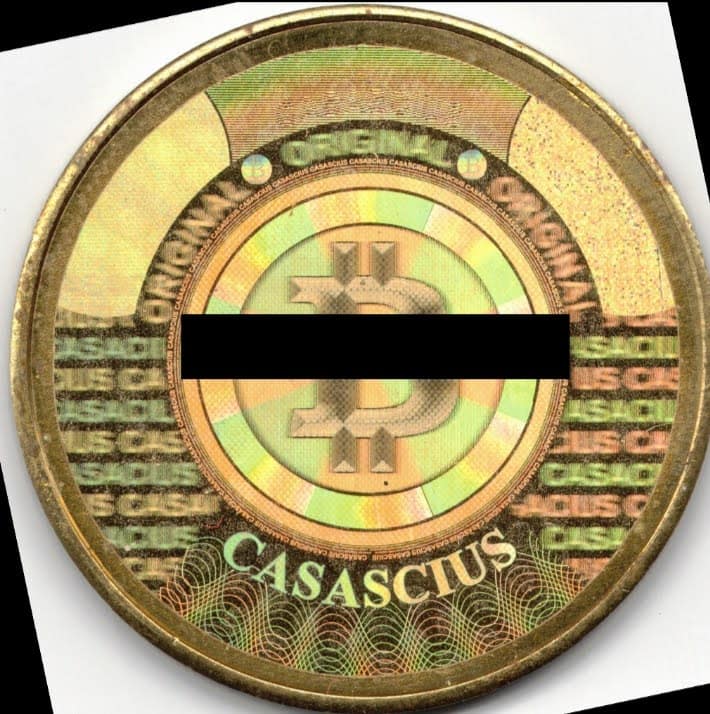
In an extremely rare on-chain event, two legendary Casascius physical Bitcoins — totaling 2,000 BTC — have just moved after being untouched for over 13 years. These coins belong to one of the earliest eras of Bitcoin’s history, making this activity significant for both collectors and analysts.
🔍 Historic Coins From 2011 & 2012 Wake Up
Blockchain records show:
One Casascius coin was minted in October 2012, when Bitcoin traded at $11.69.
The second one dates back to December 2011, when Bitcoin was worth just $3.88.
📈 At today’s prices, the 2011 coin represents a theoretical return of nearly 2.3 million percent — excluding manufacturing costs.
Bitcoin Market Behaviour Explained:
💡 What Are Casascius Coins?
Created between 2011–2013 by Utah entrepreneur Mike Caldwell, Casascius coins were physical metal coins loaded with real Bitcoin.
Each piece includes:
A private key printed on paper
Sealed with a tamper-proof hologram
Denominations: 1, 5, 10, 25, 100, 500, and 1,000 BTC
These coins became some of the most valuable collectibles in Bitcoin history.
Production stopped after FinCEN questioned whether Caldwell’s process counted as unlicensed money transmission.
🔐 How Casascius Coins Work
Only a handful of high-value units exist, including:
16 coins of 1,000 BTC (coins & bars combined)
6 coins of 1,000 BTC denomination
To redeem the Bitcoin, the owner must peel the hologram and reveal the private key. After redemption, the coin retains collector value but loses Bitcoin value.
💬 Will 2,000 BTC Hit the Market?
Not necessarily.
A previous owner of a 100 BTC Casascius coin told Cointelegraph:
“I moved it for safety, not because I want to sell.”
So movement of old Bitcoin doesn’t automatically mean large selling pressure.
This awakening simply highlights how much early Bitcoin wealth still exists — untouched for more than a decade.
🔹 Title (SEO Optimized):
2,000 BTC Moves After 13 Years: Ultra-Rare Casascius Coins Suddenly Reactivate
Source: Analysis compiled from publicly available information and original reporting by Cointelegraph.


